Dalai Lama’s 32-Year Return to Devachan: Why His Leh Visit Matters
By: News Desk | 09 Aug 2026
Leh, Ladakh: Some journeys are measured not only by distance, but by the years between two moments.
For the 14th Dalai Lama, his return to the Devachan Campus of the Mahabodhi International Meditation Centre (MIMC) in Leh on August 9, 2026, carried precisely that sense of history.
Thirty-two years after he first visited the campus in 1994 and inaugurated and blessed it when the institution was still in its formative stage, the Tibetan spiritual leader returned to a dramatically transformed centre of Buddhist learning, humanitarian service, education and meditation.
The visit was not simply a ceremonial stop on the Dalai Lama’s Ladakh schedule. It offered a striking picture of how an institution that began with a modest vision has developed into a large spiritual and humanitarian campus — and how Ladakh continues to preserve its Buddhist heritage while navigating a rapidly changing social and political landscape.
The return also came weeks after the Dalai Lama’s 91st birthday celebrations in Leh, where thousands gathered around the spiritual leader and his message of compassion, peace and human values.
A correction that matters: Devachan belongs to MIMC
The Devachan Campus is operated by the Mahabodhi International Meditation Centre, founded by Venerable Bhikkhu Sanghasena. MIMC says its main Devachan campus in Choglamsar developed after the organisation moved there from Leh in 1991, eventually expanding across a large campus with educational, spiritual and humanitarian initiatives.
The Ladakh Buddhist Association remains an important institution in the region’s Buddhist public life, including the organisation of the Dalai Lama’s birthday celebrations in Leh, but it should not be confused with the organisation managing the Devachan Campus.
That distinction makes the latest visit even more meaningful: it was essentially a return to an institution whose journey the Dalai Lama had witnessed from its early days.
From a Vision in 1994 to a Major Humanitarian Campus
When the Dalai Lama first visited the Devachan site in 1994, MIMC was still at an early stage.
More than three decades later, the landscape has changed considerably.
MIMC describes Devachan as a centre combining meditation, spiritual education, healthcare, schooling, humanitarian programmes and community service. The organisation’s campus has grown from what was once largely barren desert into a broader institutional and community space.
The transformation reflects a wider idea associated with Bhikkhu Sanghasena and MIMC: compassion should not remain only a spiritual principle; it should be translated into practical service.
That philosophy was visible during the Dalai Lama’s latest visit.
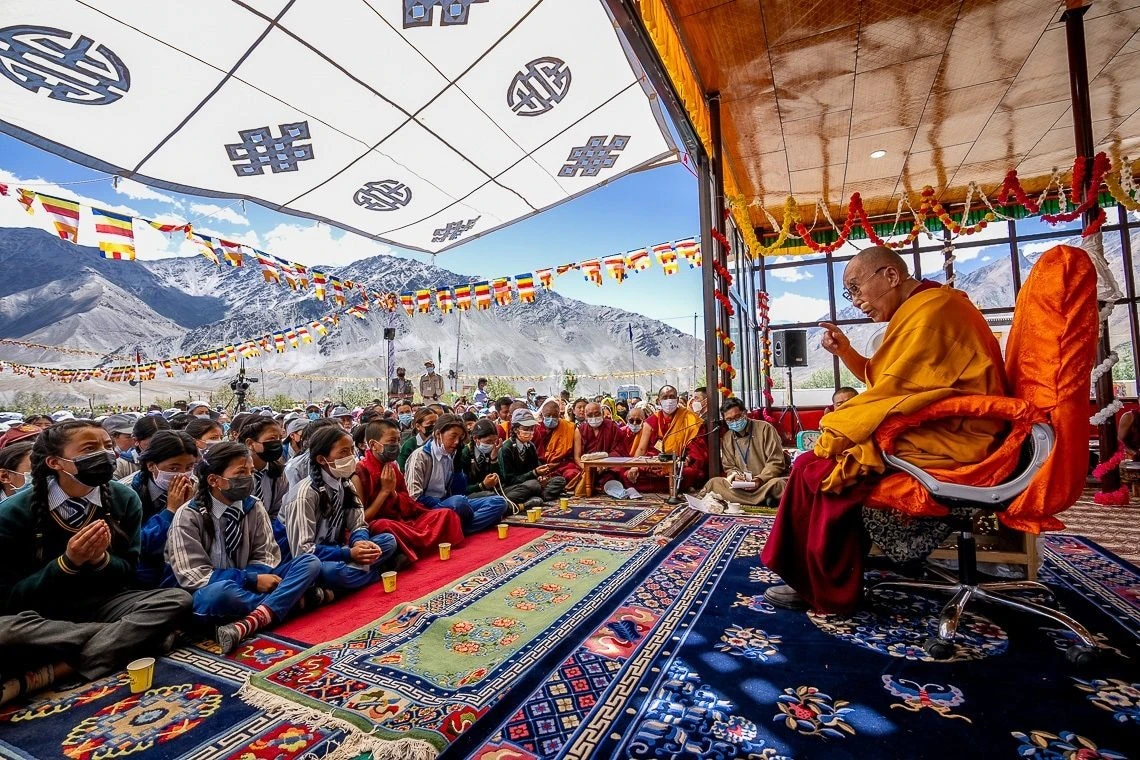
Bhikkhu Sanghasena welcomed him alongside monks, nuns, students, staff, volunteers and members of the Mahabodhi community. Students of the Mahabodhi Residential School also presented a song and explained the institution’s vision of holistic education.
For an institution built around the principles of meditation and compassionate action, the return of one of the world’s best-known Buddhist leaders offered a powerful moment of continuity.
Dalai Lama’s Visit Includes Foundation Stone, Sapling Blessing and Buddha Park
The August 9 visit was marked by several symbolic events.
One of the highlights was the laying of a foundation stone by the Dalai Lama, followed by the blessing of a sapling. MIMC presented the ceremony as a symbol of growth, renewal and its continuing emphasis on environmental responsibility.
The symbolism was particularly fitting for Devachan.
A campus that grew from difficult high-altitude conditions into an established centre of education and humanitarian work is itself an example of institutional growth. The sapling therefore represented more than a ceremonial gesture: it linked spiritual values with environmental responsibility and the long-term future of Ladakh.
The Dalai Lama also visited the MIMC Buddha Park for World Peace, where he circumambulated its 1,000 Buddha statues, known as Stongsku. The project is intended to promote world peace, compassion and the idea of humanity as one global family.
That message has been central to the Dalai Lama’s public teachings for decades.
His presence among the statues therefore created an unusually strong visual and spiritual connection between Ladakh’s Buddhist traditions and his longstanding emphasis on universal compassion.
Why Devachan Holds a Special Place in Ladakh’s Buddhist Landscape
Ladakh is often described through its mountains, high-altitude lakes and dramatic landscapes. But beneath the tourism imagery lies a deeply rooted religious and cultural tradition.
The region’s monasteries are not simply historic buildings. They remain active places of worship, meditation, religious instruction and cultural transmission. The Leh district administration describes monasteries as important centres of faith, meditation and religious education, while Ladakh Tourism presents Buddhist heritage as one of the region’s defining cultural experiences.
The best-known examples include Hemis Monastery, Thiksey Monastery and other historic monasteries spread across the Indus Valley and surrounding regions.
Thiksey, for example, is a 15th-century Tibetan Buddhist monastery and an active centre of religious learning. Hemis, meanwhile, is among Ladakh’s most prominent monastic institutions and is known for its Drukpa Buddhist lineage, religious festivals and extensive collection of Buddhist art and artefacts.
Devachan represents a somewhat different expression of this heritage.
It is not simply a centuries-old monastery. It represents a modern Buddhist institution attempting to combine spiritual practice with education, healthcare, environmental initiatives and humanitarian service.
That distinction is important in understanding why the Dalai Lama’s return resonates beyond a single religious ceremony.
The Dalai Lama and Ladakh: A Relationship Built Over Decades
The Dalai Lama has maintained a long and deep association with Ladakh.
His visits have repeatedly brought together monks, students, devotees, local communities and visitors around teachings centred on compassion, peace, non-violence and interfaith understanding.
His latest Ladakh stay also included the 91st birthday celebrations held at Jivetsal in Choglamsar on July 6. The event drew thousands of devotees, while the Dalai Lama spoke about the importance of spiritual values in helping people overcome greed, attachment and other sources of suffering.
His official office has also documented his June 28 arrival in Leh and subsequent public engagements during his 2026 Ladakh stay.
Against that background, the Devachan visit can be seen as one more chapter in a relationship that extends beyond individual ceremonies.
It connects generations — those who witnessed his early visit in 1994 and younger Ladakhis who encountered him in 2026.
A New Generation Meets an Old Spiritual Connection
Perhaps the most striking aspect of the visit was not the ceremonial welcome but the presence of students.
The Mahabodhi Residential School students presented a song and shared the institution’s vision of holistic education with the Dalai Lama.
That moment captured the broader evolution of Devachan.
In 1994, the campus represented a developing idea. In 2026, the Dalai Lama was welcomed by a community that includes students, educators, monks, nuns, volunteers and humanitarian workers.
The continuity is therefore not only institutional. It is generational.
The spiritual message that accompanied the campus in its early years has been carried forward through education and community service.
For Ladakh, where cultural preservation increasingly intersects with modern education, tourism, environmental concerns and economic change, that model has particular relevance.
Beyond Religion: Why the Visit Has Wider Meaning for Ladakh
The Dalai Lama’s return should primarily be understood as a spiritual and cultural event. However, it is difficult to separate Ladakh’s religious identity from its contemporary political and social questions.
Ladakh became a Union Territory in 2019 after the reorganisation of the former state of Jammu and Kashmir. Since then, political and civil-society groups in the region have continued to press for greater constitutional and political safeguards, including demands related to statehood and Sixth Schedule protections.
Those debates remain active in 2026. Recent developments show that representatives of the Leh Apex Body continue to raise demands concerning statehood and constitutional safeguards.
But there is an important distinction.
There is no indication from the reported Devachan programme that the Dalai Lama’s August 9 visit was a political event or that he used the occasion to intervene in Ladakh’s statehood debate.
Its significance is better understood through the lens of culture, religion, identity and continuity.
At the same time, the symbolism cannot be completely ignored.
In a region where cultural identity is closely connected with questions of heritage and representation, the presence of the Dalai Lama naturally carries a wider public resonance.
Ladakh as a Bridge Between Indian and Tibetan Buddhist Traditions
The Devachan visit also underlines Ladakh’s unusual position within the broader Buddhist world.
Ladakh’s Buddhist culture has deep historical links with Tibetan Buddhism, while the region itself is firmly situated within India.
This gives Ladakh a distinctive cultural position.
Its monasteries preserve Tibetan Buddhist traditions, its communities maintain local Ladakhi practices, and its institutions increasingly engage with wider Indian and international Buddhist networks.
That role was visible earlier in 2026 when the Mahabodhi International Meditation Centre hosted an international conference on the contribution of Himalayan Buddhism to India’s spiritual and cultural heritage. Scholars, spiritual leaders, policymakers and practitioners participated in the event.
The Devachan Campus has consequently become part of a larger conversation: how Himalayan Buddhist traditions can remain rooted in their local communities while also engaging with the wider world.
From Compassion to Conservation: A Message for the Future
The blessing of a sapling during the Dalai Lama’s visit may appear modest compared with the larger ceremonial elements of the programme.
Yet it carries a message that fits increasingly well with Ladakh’s present realities.
The high-altitude Himalayan ecosystem is environmentally fragile. Water availability, waste management, tourism pressure, changing weather patterns and the sustainability of infrastructure are becoming increasingly important questions for the region.
MIMC’s emphasis on environmental responsibility therefore adds another dimension to its spiritual mission.
The same philosophy also appeared in the centre’s association with the forthcoming International Black-Necked Crane Festival, aimed at building awareness around conservation of the species and its fragile Himalayan habitat.
For Ladakh, the preservation of Buddhist heritage and the preservation of the Himalayan environment increasingly belong to the same conversation.
Both involve protecting something valuable for future generations.
Mahakaruna University: MIMC’s Next Ambition
The visit also offered a glimpse into the institution’s future.
Bhikkhu Sanghasena shared plans for a proposed Mahakaruna University, envisioned as a centre focused on the study, practice and propagation of universal compassion.
If realised, the project could take the Devachan model another step forward — from a centre of meditation and humanitarian activity towards a broader institution for education, research and engagement with Buddhist philosophy and human values.
The timing is significant.
As technology, artificial intelligence and social change reshape education and public life, institutions such as MIMC are increasingly exploring how ancient ethical traditions can contribute to modern debates.
MIMC is also preparing to host an international conference on AI, spirituality, education and compassion, showing how its agenda is expanding beyond conventional religious programmes.
What the 32-Year Gap Tells Us
There is something inherently powerful about returning to a place after 32 years.
The Dalai Lama first came to Devachan in 1994, when the institution was still taking shape.
In 2026, he returned to find schools, healthcare services, meditation programmes, humanitarian initiatives and a major Buddha Park occupying the campus.
The physical landscape had changed.
So had the institution.
But the central idea remained remarkably consistent: compassion expressed through action.
That continuity may ultimately be the most important takeaway from the visit.
The story is not simply about an elderly spiritual leader returning to a familiar place.
It is about an institution showing what can happen when a spiritual vision survives long enough to become an intergenerational community.
Dalai Lama’s Devachan Visit: 5 Key Takeaways
1. A 32-year spiritual homecoming
The Dalai Lama returned to the Devachan Campus on August 9, 2026, 32 years after his first visit in 1994, when he inaugurated and blessed the campus.
2. Devachan has grown far beyond its early beginnings
MIMC has developed Devachan into a multi-dimensional centre combining spirituality, education, healthcare, humanitarian service and meditation.
3. The visit highlighted the next generation
Students of the Mahabodhi Residential School participated in the programme, underlining the importance of education in carrying Ladakh’s cultural and ethical traditions forward.
4. The Buddha Park reinforced the peace message
The Dalai Lama visited the Buddha Park for World Peace and circumambulated its 1,000 Buddha statues, reinforcing themes of compassion, peace and universal human responsibility.
5. The symbolism extends beyond religion
While the visit was fundamentally spiritual and cultural, it comes amid wider debates about Ladakh’s identity, constitutional safeguards and its future as a Union Territory. The event itself, however, was not reported as a political intervention in those debates.
The Larger Picture: A Spiritual Legacy Meets a Changing Ladakh
Ladakh today stands at a crossroads.
It is simultaneously a Himalayan cultural region, a major tourism destination, a centre of Buddhist learning, a strategically important border territory and a Union Territory undergoing an evolving political conversation.
In that complex setting, the Dalai Lama’s return to Devachan carried a quieter message.
Not every important moment needs to be political.
Sometimes its significance lies in continuity.
A place he blessed in 1994 welcomed him again in 2026. The barren landscape of the early years has been transformed into a functioning institution serving students, patients, monks, visitors and communities. And the principles of compassion, peace and service remain at the heart of its work.
For the people gathered at Devachan, the visit was therefore more than a reunion.
It was a reminder that cultural heritage is not preserved only in old monasteries, ancient manuscripts or historic rituals.
It can also live in schools.
It can live in hospitals.
It can live in environmental projects.
It can live in young students carrying an old tradition into a new century.
And, perhaps most importantly, it can live in the simple idea that spiritual teachings matter most when they become part of everyday human life.
Thirty-two years after he first blessed Devachan, the Dalai Lama returned to a campus that had grown — but whose central message had remained the same: compassion in action.